How to Prepare Your Body for Hiking Season in Killington 🥾🏔️
Aug 15, 2026
by Beth Roberts
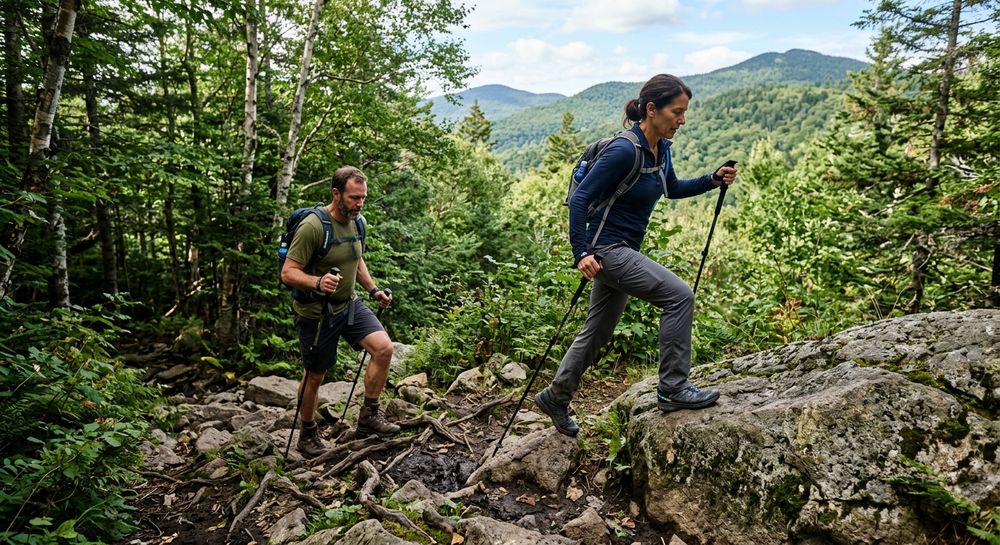
Hiking looks simple until the trail starts climbing.
A few miles of uneven terrain, steep elevation changes, rocks, roots, and long descents can challenge your legs, lungs, balance, and core more than expected.
That is especially true around Killington, where an active mountain lifestyle provides plenty of opportunities to get outside.
But simply walking more is not always enough preparation.
If you want to feel stronger on the trail, maintain your energy during longer hikes, and recover better afterward, preparing your body before hiking season can make a significant difference.
At Killington Boot Camp, our Cross Training Programs help active adults develop the strength, conditioning, mobility, and stability that translate directly to outdoor adventures.
🥾 What Hiking Actually Demands From Your Body
Hiking is much more than cardiovascular exercise.
Your body must repeatedly produce and absorb force while adapting to changing terrain.
Your quadriceps work hard during climbs and descents. Your glutes help propel you uphill. Your calves and ankles stabilize each step. Your core helps maintain balance when the terrain becomes unpredictable.
Your cardiovascular system also needs enough endurance to keep you moving as elevation and distance increase.
That means hiking preparation should address several areas rather than relying on cardio alone.
💪 Build Stronger Legs Before Hitting the Trails
Leg strength is one of the most valuable assets you can bring to a hike.
Exercises such as squats, lunges, step-ups, deadlifts, and loaded carries can strengthen the muscles responsible for climbing and controlling your body during descents.
The downhill portion is particularly easy to underestimate.
Walking downhill requires your muscles to control your body as gravity pulls you forward. If your legs are not prepared for that demand, your knees and quadriceps may feel it quickly.
Our Group Strength and Conditioning Classes incorporate functional movements that help prepare your lower body for these real-world demands.
🏔 Train for Elevation, Not Just Distance
A five-mile hike across flat terrain and a five-mile mountain hike can feel like completely different activities.
Elevation changes the equation.
Rather than only increasing walking distance, include conditioning that challenges your cardiovascular system at different intensities.
This can include rowing, cycling, brisk incline walking, circuits, and other conditioning exercises.
The objective is not to exhaust yourself every workout.
It is to gradually improve your ability to work, recover, and continue moving.
⚖️ Do Not Ignore Balance and Stability
Mountain trails are rarely perfectly smooth.
Rocks, roots, mud, loose gravel, and changing elevations require your body to constantly make small adjustments.
Good balance can help you react more effectively when your footing changes.
Single-leg exercises, carries, lunges, controlled step-ups, and core stability work can all improve this ability.
This is one reason cross-training can be particularly valuable for people who enjoy hiking. You are preparing your body for unpredictable movement rather than exercising only in one direction.
🧠 Your Core Does More Than Give You Abs
Your core acts as a stabilizing system between your upper and lower body.
While hiking, it helps you maintain posture, control rotation, carry a backpack, and remain stable when navigating difficult terrain.
A hiking-focused training plan should therefore include movements that challenge the core to resist unwanted movement.
Carries, planks, controlled rotational exercises, and compound strength movements can all contribute.
The goal is not hundreds of crunches.
The goal is a stronger, more stable body.
🧘 Mobility Can Make Long Hikes More Comfortable
Strength and endurance matter, but restricted movement can still make hiking uncomfortable.
Limited ankle mobility can affect how you climb. Tight hips can change your stride. Restricted movement through the back and shoulders may become more noticeable when carrying a pack.
Regular mobility work can help your body move more naturally.
At Killington Boot Camp, Block Therapy Sessions can complement training by supporting fascia health, mobility, breathing, and recovery.
This can be particularly useful for active adults balancing gym training with skiing, hiking, biking, and other outdoor activities throughout the year.
📅 How Far Ahead Should You Start Training?
You do not need to wait until the week before your first major hike.
Giving yourself several weeks to gradually increase strength and conditioning allows your body time to adapt.
A simple weekly approach might include:
- Two or three structured strength and conditioning sessions
- One or two lower-intensity cardio sessions
- Regular walking
- Mobility and recovery work
- Gradually longer outdoor walks or hikes
The exact schedule should depend on your current fitness level, hiking experience, and goals.
If you are starting from a lower fitness level, the answer is not to immediately train harder. Start with manageable sessions and gradually increase the challenge.
🚫 What People Often Get Wrong About Hiking Preparation
A common mistake is assuming the best way to prepare for hiking is simply to hike more.
Hiking itself is excellent preparation, but strength training can address weaknesses that hiking alone may not improve efficiently.
Another mistake is focusing entirely on cardiovascular fitness.
You might have excellent endurance but still struggle if your legs lack the strength to control repeated descents.
Finally, do not wait until something hurts before thinking about mobility and recovery.
A balanced approach prepares you for the entire experience.
🎒 What About Carrying a Backpack?
If you plan to hike with a pack, your training should account for it.
Loaded carries are an excellent way to develop grip strength, core stability, posture, and total body endurance.
As your hiking date approaches, you can also gradually practice walking with the amount of weight you expect to carry.
Avoid suddenly loading a heavy backpack and walking several miles if your body is not accustomed to it.
Progress gradually.
❓ Frequently Asked Questions
Is strength training good for hikers?
Yes. Strength training can improve lower body strength, core stability, balance, and your ability to manage climbs, descents, and uneven terrain.
How often should hikers strength train?
For many recreational hikers, two or three structured strength sessions per week can provide a strong foundation. Your ideal frequency will depend on your fitness level and other activities.
Should I train differently for mountain hiking?
Mountain hiking generally requires greater preparation for elevation, uneven surfaces, and long descents. Lower body strength, conditioning, balance, and mobility become especially valuable.
Can beginners use cross training to prepare for hiking?
Absolutely. Cross training can be scaled to your current ability. A coach can modify movements, resistance, and intensity while you gradually develop fitness.
What should I do after a difficult hike?
Hydration, nutrition, sleep, gentle movement, and mobility work can all support recovery. Block Therapy may also be incorporated into a broader recovery routine.
💥 Get Ready for Your Next Killington Adventure
You do not have to be an elite athlete to enjoy the mountains.
But being stronger, better conditioned, and more mobile can make the experience significantly more enjoyable.
Instead of spending your hike wondering when your legs will give out, you can focus on the trail, the scenery, and the reason you went outside in the first place.
Our Cross Training Programs, Personal Training, and Block Therapy Sessions can help you build a body that is ready for an active lifestyle in Killington.
Train for the trail now, so you can enjoy the mountain later. 🥾🏔️